
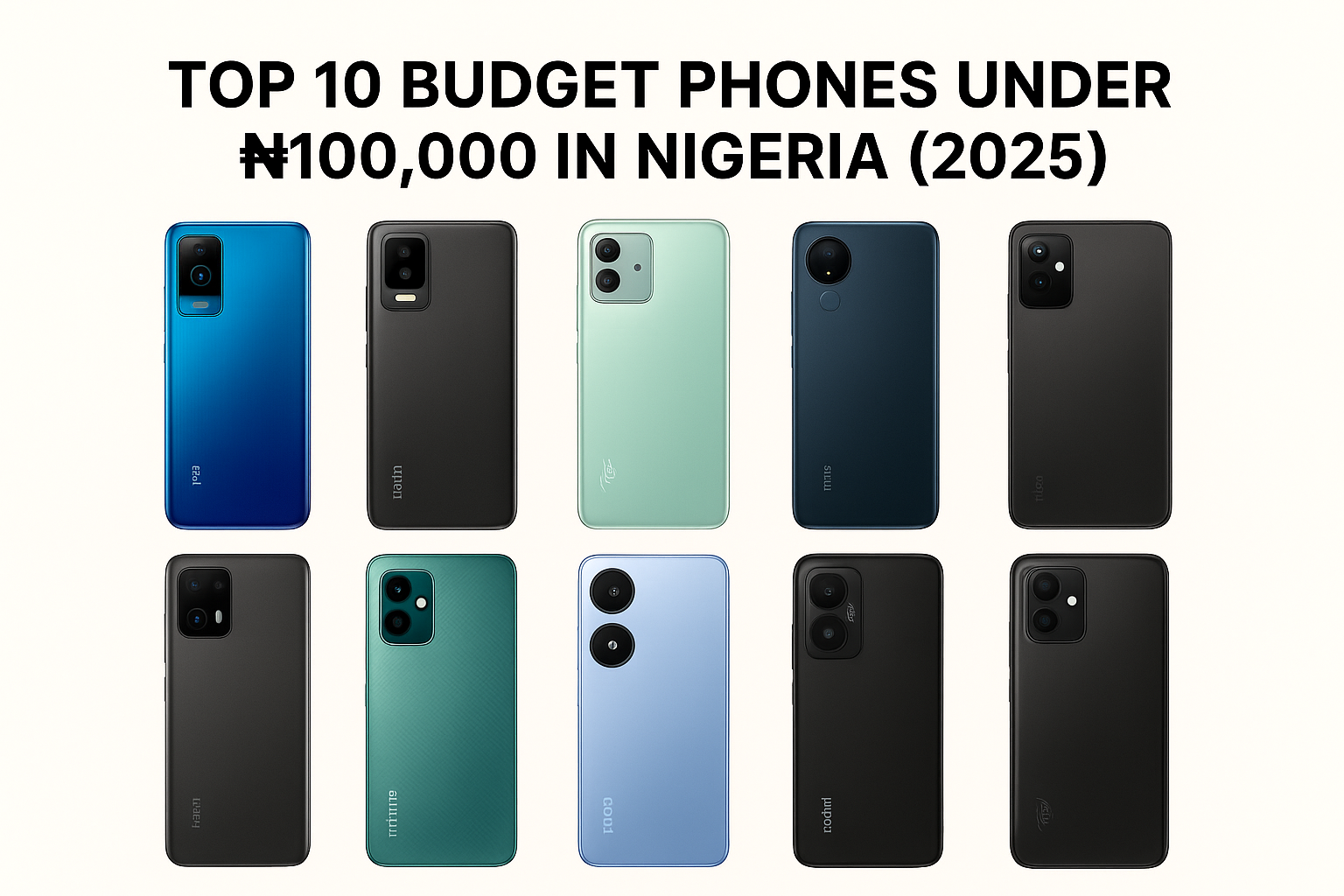
Top 10 Budget Smartphones Under ₦100,000 in Nigeria (2025 Price Guide)
10 Best Phones Under ₦100,000 in Nigeria (2025)
If you’re shopping on a tight budget around ₦100,000, you’re not alone. For many Nigerians — especially students, young professionals, and everyday users — ₦100k is the sweet spot: affordable enough, yet capable of delivering a smartphone experience that handles WhatsApp, social media, YouTube, and everyday tasks without breaking a sweat.
In 2025 the Nigerian smartphone market has grown a lot. Phones in this budget bracket now come with bigger screens, 5,000 mAh batteries, 50 MP cameras, and enough RAM/storage to last you 1–2 years at least. That’s a far cry from the old days where “budget phone” meant tiny display and sluggish performance.
In this guide, we’ve rounded up the 10 best phones under ₦100,000 (or around that mark) that strike a solid balance between price and value. I’ll walk you through specs, what works (and what doesn’t), and who each phone is best for — like I’m chatting with a friend who’s shopping for a new device.
Quick Comparison Table
Rank | Phone | Typical Price (₦) | Display | Battery | Main Camera | Best For | Where To Buy |
|---|---|---|---|---|---|---|---|
1 | Itel A80 | 95,000 – 100,000 | 6.7″ | 5000 mAh | 50 MP | Value-conscious users, social media lovers | |
2 | Itel P65 | 99,000 – 150,000 | 6.7″ | 5000 mAh | 50 MP | Users wanting storage + battery balance | |
3 | Xiaomi Redmi A5 4G | 96,000 – 140,000 | 6.9″ | 5200 mAh | 32 MP | Big-screen fans, long battery users | |
4 |
| 90,000 – 100,000 | 6.5″ | 5000 mAh | 13 MP | Basic users, light social media | |
5 | Itel A90 | 94,000 – 135,000 | 6.6″ | 5000 mAh | 13 MP | Budget-conscious users | |
6 | HMD Aura | 97,000 – 123,000 | 6.6″ | 5000 mAh | 13 MP | Everyday users wanting balance | |
7 |
| 99,000 – 124,000 | 6.6″ | 5000 mAh | 13 MP | Light phone users, students | |
8 | Xiaomi Poco C61 | 92,000 – 123,000 | 6.7″ | 5000 mAh | 8 MP | Basic tasks, light camera users | |
9 | Xiaomi Redmi A3x | 89,000 – 139,000 | 6.7″ | 5000 mAh | 8 MP | Entry-level smartphone needs | |
10 | Itel A50C | 95,000 – 115,000 | 6.6″ | 4000 mAh | 8 MP | Ultra-budget users |
Top 10 Phones (Detailed Reviews)
Itel A80
Price & Availability: Roughly ₦95,000–₦100,000 — widely available on Jumia, Konga and Slot stores nationwide; stock usually steady.
Key Specs: 6.7″ display, 5,000 mAh battery, 50 MP main camera, storage/RAM variants: 128 GB + 3 GB RAM or 128 GB + 4 GB RAM.
Why We Love It: It’s rare to find a ₦100k phone with a 50 MP camera and big 6.7″ screen — ideal for social media, videos, and everyday snaps. The 5,000 mAh battery is great for Nigerian power realities (NEPA cuts, long commutes).
Nigerian Context:
🔋 Battery life: With light to moderate use (calls, WhatsApp, social media), expect a full day and into the next — maybe 18–24 hours. With NEPA, it’s a reliable backup.
Network: Works smoothly on MTN, Airtel, Glo and 9mobile — no fancy 5G here but 4G is sufficient for streaming and browsing.
Durability: Plastic build is light; should survive daily use but avoid extreme heat exposure or long sun exposure.
Availability: Because Itel is common in Nigeria, you’ll easily find this phone even outside major cities.
Best For: Students, social media lovers, first-time smartphone owners.
Pros:
✅ Excellent 50 MP camera at this price.
✅ Large 6.7″ display — good for videos and browsing.
✅ Big 5,000 mAh battery — solid for everyday Nigerian use.
Cons:
❌ RAM only 3–4 GB — limited multitasking.
❌ No 5G support, and likely just HD+ display (not Full HD).
Bottom Line: A strong all-rounder under ₦100k — ideal for video, social media and everyday use.
See Full Specs & Prices → Itel A80 page
Itel P65
Price & Availability: ~₦99,000 base variant; higher-RAM/storage versions may go up to ~₦150,000 — but basic model still close to ₦100k.
Key Specs: 6.7″ display, 5,000 mAh battery, 50 MP main camera, RAM/storage: 128 GB + 4 GB / 128 GB + 8 GB / 256 GB + 6 GB RAM.
Why We Love It: If you can catch the 4 GB-RAM base model, this phone gives big display, big battery and a 50 MP camera — and still stays budget-friendly.
Nigerian Context:
🔋 Battery: Should last a whole day easily; good power-outage backup.
Network: 4G support covers all major carriers — perfect for streaming and browsing in Lagos or Abuja.
Durability: Typical Itel build — light and easy to carry; maybe not the toughest but acceptable.
Availability: Itel devices are widespread — chances are good you’ll find one even in smaller cities.
Best For: Users who want good storage/battery balance, perhaps light content creation, storing photos/videos.
Pros:
✅ 50 MP camera + large screen — solid for media.
✅ Good battery life (5,000 mAh).
✅ Storage options — plenty of space for photos, apps, media.
Cons:
❌ The base RAM (4 GB) is just okay for multitasking; higher variants push beyond ₦100k.
❌ No 5G, and screen resolution likely not FHD+.
Bottom Line: A worthwhile pick as long as you stick to the base variant — good all-rounder for media and storage.
See Full Specs & Prices → Itel P65 page
Xiaomi Redmi A5 4G
Price & Availability: Usually between ₦96,000 and ₦140,000 depending on variant and seller — base 64 GB + 3–4 GB RAM variant often found near ₦96–100k.
Key Specs: Immense 6.9″ display, 5,200 mAh battery, 32 MP main camera, storage/RAM: up to 128 GB + 6 GB RAM.
Why We Love It: Massive display — perfect for bingeing videos, reading, social media. The 5,200 mAh battery is slightly larger than average, promising long screen time.
Nigerian Context:
🔋 Battery: Great for heavy users or students who spend hours on social apps; will last through the day and possibly into the next morning if usage is moderate.
Network: As long as you have a decent 4G signal in your area, streaming and browsing are smooth. In areas with patchy reception, might need to manage data carefully.
Durability: Big phone — a bit heavier; plastic body typical of budget devices. Avoid too much sun and heat to prevent overheating.
Availability: Xiaomi phones are popular and sold on major marketplaces and shops, but demand means stock widely fluctuates.
Best For: Students, video lovers, heavy social media users, people who consume content often.
Pros:
✅ Huge 6.9″ screen — great for media and browsing.
✅ Large 5,200 mAh battery — excellent for heavy use or NEPA periods.
✅ 32 MP main camera — surprisingly good for a budget-range device.
Cons:
❌ Bigger phone — less pocket-friendly.
❌ Heavier and maybe slower if high-res video or heavy apps used regularly.
Bottom Line: If you want a big screen and battery that lasts long — for streaming, browsing, or studying — the Redmi A5 4G is a top contender.
See Full Specs & Prices → Xiaomi Redmi A5 4G page
HMD Arc
Price & Availability: Around ₦90,000–₦100,000 — one of the more affordable picks on this list.
Key Specs: 6.5″ display, 5,000 mAh battery, 13 MP main camera, 64 GB + 4 GB RAM storage.
Why We Love It: A clean, simple budget phone that covers the basics — calls, messaging, social media, light browsing — without unnecessary bells and whistles.
Nigerian Context:
🔋 Battery: 5,000 mAh is solid; for basic users (calls, WhatsApp, occasional browsing), should easily last a full day or more.
Network: 4G ready — good for cities and towns with stable network coverage.
Durability: HMD tends to build phones sturdily enough; plastic body may be light but less fragile than ultra-cheap models.
Availability: HMD isn’t as ubiquitous as Itel or Xiaomi, but you may find it on major online marketplaces or select shops.
Best For: First-time smartphone users, budget buyers, or basic-phone replacement seekers.
Pros:
✅ Affordable and covers essential tasks.
✅ 5,000 mAh battery — good uptime.
✅ Lightweight and simple to use.
Cons:
❌ Camera only 13 MP — modest by 2025 standards.
❌ Display and performance will feel basic — not for heavy use or multitasking.
Bottom Line: A decent, no-frills phone for basic everyday use — perfect if you just need a reliable smartphone without spending much.
See Full Specs & Prices → HMD Arc page
Itel A90
Price & Availability: Usually around ₦94,000 for base variant; higher storage options may go up to ~₦135,000.
Key Specs: 6.6″ display, 5,000 mAh battery, 13 MP main camera, storage/RAM combos from 64 GB + 3 GB up to 256 GB + 4 GB.
Why We Love It: Balanced — not flashy but reliable for everyday calls, messaging, browsing, and social media. Large battery and display make it a good daily driver.
Nigerian Context:
🔋 Battery: 5,000 mAh should easily power you through a full day, even with heavy WhatsApp, calls or browsing.
Network: Standard 4G — sufficient for streaming and social media.
Durability: Typical plastic build — nothing premium, but fine for daily use.
Availability: Itel phones are everywhere, so finding a unit — even in smaller towns — is usually easy.
Best For: Students, workers on a budget, everyday users needing a simple smartphone.
Pros:
✅ Solid battery and display size.
✅ Affordable base price.
✅ Decent storage options if you go for higher variants.
Cons:
❌ Camera is just average (13 MP).
❌ RAM may feel tight with heavier multitasking.
Bottom Line: A safe, no-surprise pick under ₦100k — good for everyday tasks and basics.
See Full Specs & Prices → Itel A90 page
HMD Aura
Price & Availability: Typically ₦97,000–₦123,000 depending on variant. Base models hover close to ₦100k.
Key Specs: 6.6″ display, 5,000 mAh battery, 13 MP main camera, storage: 64 GB or 128 GB + 4 GB RAM.
Why We Love It: A clean mid-range feel at a budget price — good for users who want a balance of screen, battery, and manageable performance in a simple phone.
Nigerian Context:
🔋 Battery: Good 5,000 mAh capacity — can stretch through NEPA outages comfortably.
Network: 4G support works fine on MTN, Airtel, Glo, 9mobile.
Durability: Lightweight and digestible build — should be fine with careful use.
Availability: Less common than Itel or Xiaomi, but still available on popular online shops and select retailers.
Best For: Everyday smartphone users, casual social media users, first-time smartphone upgraders.
Pros:
✅ Balanced specs for its price.
✅ Good battery life.
✅ Manageable size — easy to carry about.
Cons:
❌ Camera only 13 MP — not ideal for serious photography.
❌ No 5G, and performance may lag on heavier apps.
Bottom Line: A balanced, no-frills budget smartphone — good for everyday use without over-spending.
See Full Specs & Prices → HMD Aura page
Infinix Smart 10 HD
Price & Availability: About ₦99,000–₦124,000 depending on variant; base model tends to hover around that ₦100k mark.
Key Specs: 6.6″ display, 5,000 mAh battery, 13 MP main camera, 64 GB + 2 GB RAM.
Why We Love It: As a budget-friendly Infinix phone, it covers basics well — good for students, first-time smartphone buyers or backup device users.
Nigerian Context:
🔋 Battery: 5,000 mAh battery gives comfortable uptime for daily rounds — calls, social media, light browsing.
Network: Standard 4G — fine unless you need heavy data streaming.
Durability: Infinix builds tend to be relatively sturdy; reasonable for daily pocket use.
Availability: Infinix is popular across Nigeria — finding this phone even outside major cities is possible.
Best For: Students, budget buyers, simple everyday users.
Pros:
✅ Affordable price and battery life.
✅ Decent display size for browsing and social media.
✅ Infinix brand has good local support for repairs/after-sales.
Cons:
❌ RAM only 2 GB — seriously limits multitasking.
❌ Camera and performance only good enough for basics.
Bottom Line: Good as a first smartphone or a simple backup — basic but dependable under ₦100k.
See Full Specs & Prices → Infinix Smart 10 HD page
Xiaomi Poco C61
Price & Availability: Usually ₦92,000–₦123,000 depending on seller and storage variant. Base variants often hit around ₦95k–100k.
Key Specs: 6.7″ display, 5,000 mAh battery, 8 MP main camera, storage/RAM: up to 128 GB + 6 GB RAM.
Why We Love It: A big screen and battery make it good for browsing and light media — and for a Xiaomi device, it offers decent brand reliability.
Nigerian Context:
🔋 Battery: 5,000 mAh — should power you well through a busy day of browsing or social use.
Network: Works with all major 4G networks in Nigeria.
Durability: Solid build for daily use, but watch out for bright sun and heat during Lagos traffic.
Availability: Xiaomi/Poco phones are popular, but demand fluctuates — so you might need to check a couple of retailers.
Best For: Casual users, social media users, light browsing, and budget-conscious buyers wanting a big screen.
Pros:
✅ Big 6.7″ display — nice for videos, browsing.
✅ Big battery — good for all-day use.
✅ Xiaomi brand gives some assurance on build quality and software support.
Cons:
❌ 8 MP camera is weak by 2025 standards.
❌ Performance will struggle with heavy apps or multitasking.
Bottom Line: A budget-friendly, big-screen phone — good for media and basic use, but don’t expect strong photos or heavy app performance.
See Full Specs & Prices → Xiaomi Poco C61 page
Xiaomi Redmi A3x
Price & Availability: Roughly ₦89,000–₦139,000 depending on variant and seller. Base models often near ₦90k.
Key Specs: 6.7″ display, 5,000 mAh battery, 8 MP main camera, storage up to 128 GB + 4 GB RAM.
Why We Love It: For less than ₦100k, you get a big screen and large battery — perfect for simple daily tasks, browsing, and social media.
Nigerian Context:
🔋 Battery: 5,000 mAh — good for daily use or as a backup phone during NEPA outages.
Network: 4G works fine on all major Nigerian carriers.
Durability: Standard plastic build — fairly light and manageable.
Availability: Xiaomi phones are well distributed, though demand may cause fluctuations in stock and price.
Best For: Entry-level smartphone users, backup phone seekers, very budget-conscious buyers.
Pros:
✅ Affordable, sometimes below ₦90k.
✅ Big screen and decent battery.
✅ Good brand support and availability.
Cons:
❌ Camera only 8 MP — subpar for photos.
❌ Performance is basic — not ideal for heavy apps or multitasking.
Bottom Line: A no-frills, budget entry-level phone — good for calls, social media, and light use.
See Full Specs & Prices → Xiaomi Redmi A3x page
Itel A50C
Price & Availability: Commonly found around ₦95,000–₦115,000 depending on seller and storage variant.
Key Specs: 6.6″ display, 4,000 mAh battery, 8 MP main camera, 32 GB + 2 GB RAM storage (ultra-basic).
Why We Love It: Despite being the most basic option here, it’s perfect for those who just want a simple, working Android phone under ₦100k for calls, WhatsApp, and light browsing.
Nigerian Context:
🔋 Battery: 4,000 mAh — sufficient for a day’s light use, but may require late-day charging.
Network: 4G support is good for major cities; manageable for basic connectivity needs.
Durability: Itel plastic build — simple and lightweight, but treat with care.
Availability: Itel phones are everywhere — easy to find in markets and online stores across the country.
Best For: Ultra-budget buyers, first-time smartphone users, secondary phones.
Pros:
✅ Very affordable.
✅ Simple and easy to use.
✅ Good enough for basic apps like calls, WhatsApp, light browsing.
Cons:
❌ 2 GB RAM is very limited — multitasking will struggle.
❌ Battery and camera are modest by 2025 standards.
Bottom Line: A budget entry-level phone — best for basic needs or as a backup device.
See Full Specs & Prices → Itel A50C page
How to Choose the Right Phone Under ₦100k
When you’re shopping on a budget, it’s smart to know what matters — and what to compromise. Here’s my advice, friend to friend:
Priority 1: Battery Life
In Nigeria, with frequent NEPA outages or unstable power, having at least 5,000 mAh is a lifesaver. Phones like Itel A80, Redmi A5 4G, and HMD models give you that — meaning even if NEPA comes knocking late evening, you don’t panic. A battery of 4,000 mAh (like on Itel A50C) can work — but you’ll need to charge before night sets.
Priority 2: Display Size & Quality
A display of 6.5″ or more is ideal for browsing, watching videos, and social media scrolling. Larger screens are easier on the eyes and better for content. While most in this list are HD+ (720p-ish), a bigger screen still gives you a comfortable viewing experience.
Priority 3: Camera (If You Use Social Media or Take Photos)
If you take lots of photos, go for a 13 MP or higher main camera — better yet 32 MP or 50 MP (like on Redmi A5 4G or Itel A80). For casual selfies and social media, even 8–13 MP works — but don’t expect DSLR-level quality.
Priority 4: RAM & Storage
At least 3–4 GB RAM makes everyday apps and browsing smoother. For heavy apps, multitasking, or storing lots of photos/videos — get 64 GB+ storage, ideally 128 GB. If you plan to store music, videos or lots of photos, microSD support is a plus.
Priority 5: Brand Reliability & After-Sales Support
In Nigeria, recalling that your phone might need servicing or spare parts down the road — going with brands with good local support (like Itel, Infinix, Xiaomi) is wise. That way, if something goes wrong, you’re not stuck without help.
What to Expect at ₦100k in 2025
At this price point in 2025, you get:
Display:
6.5" to 6.9" screens — that’s the norm now.
HD+ (720p) resolution; Full HD+ is rare (so don’t expect crispness like flagship devices).
IPS LCD panels are common; AMOLED only appears on higher-end phones.
Refresh rates ~ 60 Hz; smoothness is basic (no high refresh).
Battery:
Minimum 4,000 mAh; most “good” models give 5,000 mAh+.
For many, this means 1–2 days per full charge with moderate use.
Fast charging (18W or 33W) is a bonus — though at this price many phones have standard charging.
Camera:
Main cameras range 8 MP to 50 MP — but quality depends on lens and software, not just megapixels.
In good daylight, expect decent photos; at night or indoors, expect grainy or washed-out shots.
Front cameras usually 5–8 MP — fine for video calls or casual selfies, but not premium.
Performance:
Entry-level processors (MediaTek / inexpensive octa-core chips).
RAM rarely above 4 GB (some 6 GB exceptions); enough for WhatsApp, browsing, light apps.
Storage 32–128 GB; microSD support helps for photos/videos.
Gaming? Light casual games only — don’t expect smooth high-graphics gaming.
Build:
Mostly plastic bodies (lightweight but less premium).
Limited or no water resistance — don’t expect to survive heavy rain or splashes.
Not much premium build quality; treat gently to avoid breaks or scratches.
Where to Buy These Phones in Nigeria
If you’re ready to buy, these are the retailers that usually stock budget phones and offer reasonable pricing:
Jumia Nigeria — wide selection, delivery across Nigeria, and often offers discounts or bundling deals.
Konga — sometimes better deals than Jumia, and good customer support.
Slot Nigeria — physical stores nationwide; good if you want to inspect the phone before buying.
Pointek — often used by small business owners or those buying in bulk; can yield discounts.
Shopping tips:
Always check price on 9japhones first — you might save ₦5,000–₦15,000 compared to other retailers.
Watch for sales periods (Black Friday, New Year deals) — that’s when new stocks hit and prices can drop.
Consider buying last year’s models — usually ₦20k–₦30k cheaper but still offer solid performance.
Look for bundle deals (free power bank, Bluetooth headset) to maximize value.
Read reviews — especially on battery life and durability — before committing.
Frequently Asked Questions (FAQ)
Q: What’s the best phone under ₦100k for students?
A: For students, I’d recommend Itel A80 — great balance of screen size, good battery and nice 50 MP camera. If you want big display for reading, videos or social media, Xiaomi Redmi A5 4G is also excellent.
Q: Can I get a phone with a good camera under ₦100,000?
A: Yes — phones like Itel A80 (50 MP) and Redmi A5 4G (32 MP) give decent photos under good light. Just don’t expect night-mode or premium-level photography.
Q: Which is better: Itel or Infinix (or Xiaomi)?
A: It depends on what you prioritize. Itel gives affordability and common availability. Xiaomi tends to offer slightly better cameras and sometimes more storage, but price and availability fluctuate. Infinix — like Smart 10 HD — can be good for basic use with reliable local support.
Q: Will these phones last 2–3 years?
A: Realistically — maybe, if you treat them well, avoid overheating, and don’t overload them with heavy apps. Budget phones degrade faster than flagships; you may need to replace within 2–3 years.
Q: Is buying a used flagship better than a new budget phone?
A: Pros: you might get better performance, camera or build quality. Cons: used phones in Nigeria often lack warranty, may have battery degradation or unknown wear. For reliability and peace of mind — especially if you plan to use daily — a new budget phone is often a safer bet.
Conclusion
With ₦100,000 — or close — you can still get a solid, usable smartphone in 2025. Our top pick for overall value is Itel A80 — balancing display, camera, battery and price like a champ.
If your main concern is just basic use or you’re on a tight budget — Itel A50C or HMD Arc give you a smartphone that handles calls, WhatsApp and social media without stress.
For camera and media users, Xiaomi Redmi A5 4G and Itel P65 stand out.
No matter your need — budget phone, first smartphone, backup device or everyday driver — there’s something on this list for you.
👉 Want to compare real-time prices across all Nigerian retailers? Head to 9japhones now and make sure you get the best deal before you pay.